Why does rainstorm cause disaster?
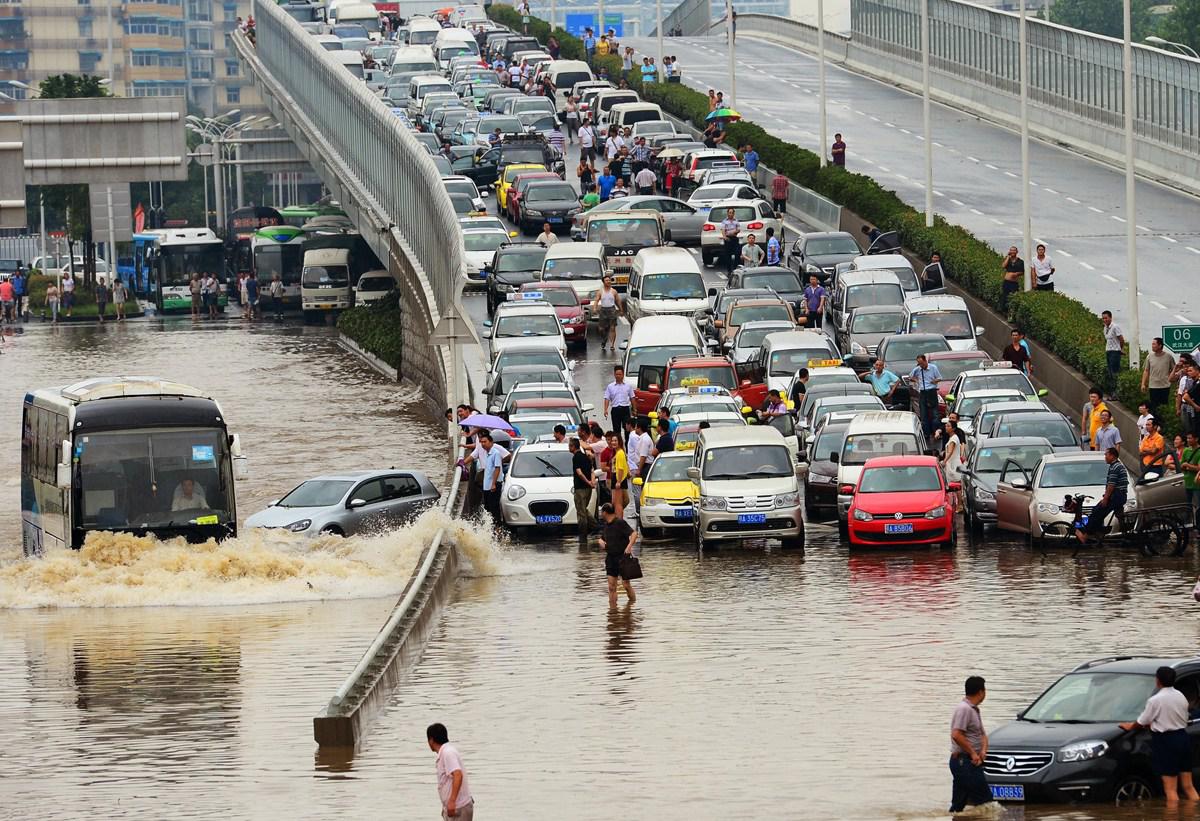
Urban water accumulation. Image source: Network
When rainstorm weather occurs, it is often accompanied by lightning and gale, which often leads to flash floods, river flooding, waterlogging, destruction of crops, buildings and materials, casualties of people and animals, crop failure or failure, traffic and communication obstruction, etc. Heavy rain can directly cause disasters, and also easily induce geological disasters such as collapse, landslide and debris flow. Rainstorm and flood disasters involve industrial and agricultural production, transportation, communication, building facilities, urban operation, people’s daily life, ecological environment and other aspects.
Rainstorm itself is a natural phenomenon, but it is also one of the most important disastrous weather in China. In other words, rainstorm is potentially destructive and dangerous. If a rainstorm does not directly cause casualties and social property losses, it is not a rainstorm disaster. There are several factors that determine whether a rainstorm causes a disaster, besides natural factors such as rainfall intensity, duration and the time when a rainstorm occurs, it also depends on social and human factors such as geographical environment, socio-economy, population, disaster prevention and resilience.
The intensity and duration of rainstorm are the most basic disaster-causing factors. If the rainfall of 50 mm is evenly distributed and falls within 24 hours, which is equivalent to the rainfall of 2 mm per hour, people will feel it is a gentle drizzle. But in fact, the rain does not fall evenly, and it often rains a lot in a short time. On the one hand, the intensity of rainstorm mentioned here refers to the amount of accumulated rainfall in 24 hours (1 day). For example, on November 9, 2004, there was a rare rainstorm in late autumn in Taizhou and Wenzhou, Zhejiang Province, in which Wenling’s 24-hour rainfall reached 253 mm, breaking the record of the largest daily rainfall in November in the province. On August 7, 1975, the rainfall in Shangcai, Henan Province reached 755.1 mm, which is also the extreme value of daily rainfall in China. On the other hand, it refers to the amount of rainfall per unit time, such as hourly rainfall and minute rainfall. China has recorded 5 minutes of rainfall of 53.2 mm (appearing in Meitonggou, Shanxi Province on July 1, 1971), and the extreme rainfall of 1 hour is 198.3 mm (Linzhuang, Henan Province on August 5, 1975). On July 18, 2007, a heavy precipitation weather process occurred in Shandong Province, in which the maximum rainfall in Jinan city reached 151 mm in one hour, the highest in history since 1958. On July 21-22, 2012, a torrential rain occurred in Beijing. The rainfall was concentrated in 20 hours from 10: 00 on the 21st to 6: 00 on the 22nd. The rainfall in Hebei Town of Fangshan District reached 460.0mm, and the hourly rainfall in 18 meteorological observation stations exceeded 80mm, with the maximum hourly rainfall reaching 100.3mm..
Large-scale severe rainstorm disasters have a great relationship with the long duration, or a rainstorm process lasts for several days, or there are many rainstorm processes in a period of time. For example, the rainstorm disaster in Jianghuai area in 1991 caused direct economic losses as high as 27.5 billion yuan. Not only the rainfall is heavy, but also it lasts for a long time. During May-July, there were many heavy rains. There are three main rainfall periods, with frequent rainfall in Jianghuai and nearby areas from May 18 to 26. On June 2-19, there were several torrential rains in the Jianghuai and Taihu basins. On June 12-14, the precipitation in Shouxian and Yingshang in Anhui reached 421 mm and 414 mm respectively. From June 29 to July 13, the rainy area was located in the Jianghuai and Taihu basins again, and the 24-hour precipitation in Guangmingding, Huangshan, Anhui Province reached 328.4 mm. From June to August, 1998, the torrential rain and flood disaster occurred in the whole basin of the Yangtze River, and the number of rainy days generally exceeded 40 days, and some of them reached more than 60 days. At the same time, there are persistent heavy rains in Songhua River and Nenjiang River basins, with rainfall days generally exceeding 35 days and some exceeding 55 days. In that year, the flood in economical loss reached 255 billion yuan.
When the rainstorm occurs, the geographical environment becomes an important factor affecting the occurrence of disasters. Geographical environment includes topography, landform, geographical location and river distribution. Under the action of heavy rain, the plateau and mountainous areas are most likely to induce flash floods, landslides, mudslides and other secondary disasters. Generally speaking, the terrain of basins and mountainous plain areas has a certain slope, and most of them are terraced platforms along the river, with good drainage conditions and limited flooding range, which will not cause major disasters. However, if we encounter high-intensity and large-scale heavy rain, especially persistent heavy rain, it is easy to cause serious disasters such as flooding the city. Because of its flat terrain and vast area, the plain area is dominated by flooding disasters. China’s plains are concentrated in the east, that is, the middle and lower reaches of several major rivers, such as the Yangtze River, the Yellow River, the Haihe River, the Huaihe River, the Pearl River and the Songhua River. River floods mainly come from the upper and middle reaches, and the peak height is large after entering the plains. If the flood discharge capacity of rivers is weak, it is easy to cause floods. After the flood, because the plain is flat and the flood speed is relatively slow, it is not easy to cause heavy casualties. However, the plain area has developed economy, dense population and concentrated cities. Once a serious flood disaster occurs, the economic losses and the damage to social life will be enormous.
Human factors will also play a direct or indirect role in the disaster caused by heavy rain. The destruction of forest vegetation will lead to soil erosion. On the one hand, forest can intercept precipitation, on the other hand, forest soil has high permeability and good water storage. The destruction of forests directly leads to soil erosion, siltation of river channels and elevation of river beds, which reduces the flood regulation and storage capacity of rivers and their surrounding areas. Reclaiming land around lakes affects flood storage capacity. Damming lakes and reclaiming farmland from rivers will reduce the water area of rivers and lakes, hinder the smooth flow of rivers, and greatly reduce the flood storage capacity. Once a large amount of precipitation or upstream water sinks into the river, it will cause the river to skyrocket and flood. Invade rivers or flood storage areas, resulting in poor running water. Planting crops or even building houses and roads in floodplains or flood storage areas will reduce the area of land that can absorb water, and buildings will easily flood and cause huge losses. In addition, excessive pumping of groundwater will cause land subsidence, which will also aggravate the risk of flood disaster.
When rainstorm weather occurs, it is often accompanied by lightning and gale, which often leads to flash floods, river flooding, waterlogging, destruction of crops, buildings and materials, casualties of people and animals, crop failure or failure, traffic and communication obstruction, etc. Heavy rain can directly cause disasters, and also easily induce geological disasters such as collapse, landslide and debris flow. Rainstorm and flood disasters involve industrial and agricultural production, transportation, communication, building facilities, urban operation, people’s daily life, ecological environment and other aspects.
However, heavy rain is not without its merits. Heavy rain often causes disasters, but it also benefits mankind. In the right place and at the right time, the advantages of moderate rainstorm outweigh the disadvantages. After a long drought, a heavy rain will lift the drought; During the high temperature and summer drought in southern summer, heavy rain can not only relieve the drought, but also drive away the heat; In many places in the north, the annual precipitation depends on one or two heavy rains, and there is no drought when there is heavy rain; At the moment when the contradiction of water resources is prominent, it is hoped that heavy rain will store more water in the reservoir to alleviate the shortage of urban water. Therefore, we should seek advantages and avoid disadvantages, and make scientific use of precipitation resources brought by heavy rain to benefit mankind.
(Source: Meteorological Knowledge Editor: Wang Ruojia)