Chinese and foreign artificial intelligence enterprises jointly compile and publish international standards in the field of large-scale model security.
From April 15th to 19th, the 27th United Nations Conference on Science and Technology was held in Geneva, Switzerland. During the conference, the World Institute of Digital Technology (WDTA) issued two international standards, namely, the Safety Test Standard for Generative Artificial Intelligence Applications and the Safety Test Method for Large Language Models. This is the first time that an international organization has issued an international standard in the field of large model security.
Since the popularity of large language model technology last year, the security of large language model has been the focus of international attention. World Institute of Digital Technology (WDTA) is an international non-governmental organization established and registered in Geneva in April 2023. It follows the guiding framework of the United Nations and is committed to promoting digital technology and international cooperation on a global scale. It transcends national boundaries and corporate interests and advocates global unified standards and governance mechanisms.
Professor Peter Major, the founding chairman, said, "Our goal is to set global digital standards, lead technological innovation and strengthen international cooperation." It is worth noting that OpenAI, Google, Microsoft, Meta, Ant Group, Huawei, Iflytek, International Data Space Association (IDSA), Flawn Hough Institute and China Electronics are all members of WDTA.
World Institute of Digital Technology attending the meetingArtificial intelligence safe, credible and responsible working groupTeam leader Huang Jinjin said that as artificial intelligence systems, especially large language models, continue to become an indispensable part of all aspects of society, it is crucial to solve their security challenges with a comprehensive standard. These two standards bring together the wisdom of experts in the field of global AI security, fill the gaps in the field of security testing in large language models and generative AI applications, provide a unified testing framework and clear testing methods for the industry, and help to improve the security of AI systems, promote the responsible development of AI technologies, and enhance public trust.
WDTA takes the lead in "Safety Test Standard for Generative Artificial Intelligence Applications"
It is understood that among the published international standards, WDTA is the lead unit for the Safety Test Standard for Generative Artificial Intelligence Applications.
Huang Jinjin introduced that the "Safety Test Standard for Generative AI Applications" provides a framework for testing and verifying the safety of generative AI applications. The standard covers the key areas of AI application life cycle, including basic model selection, embedding and vector database, prompt execution/reasoning, intelligent behavior, fine-tuning, response processing and runtime security of AI applications. The main goal is to ensure that the behavior of AI applications in the whole life cycle is safe and meets the expected design.
It is understood that the AI STR (Safe, Trusted and Responsible) program is the core initiative of the World Institute of Digital Technology, aiming at ensuring the safety, credibility and responsibility of artificial intelligence systems.
Official website, a reporter of Beijing News Shell Finance, visited the World Institute of Digital Technology and found that its introduction said that the AI STR plan "represents a paradigm shift in how we develop and deploy AI technology. Advocating safety, trust and responsibility in artificial intelligence system has laid the foundation for a more ethical, safer and fairer digital future. Artificial intelligence technology is the promoter of progress, not the source of uncertainty and harm. The production AI application security testing and verification standard is one of the AI STR standards. "
In addition, a framework for the development of generative artificial intelligence talents was released at the same time as the standard. According to the introduction of the World Institute of Digital Technology, generative artificial intelligence applications such as ChatGPT and Stable Diffusion quickly attracted people’s attention and imagination all over the world, thanks to their wide practicability-almost anyone can use them to communicate and create-and more natural man-machine dialogue. Even the latest generative AI applications can perform a series of daily tasks in employees’ work, such as data classification, business report generation and even automatic test code generation. A wide range of stakeholders are trying to cope with the impact of generative artificial intelligence on business and society, and more people need to understand and participate, so as to form a consensus on the scope, how to use, application scenarios and constraints of artificial intelligence, and truly realize that "artificial intelligence is human."
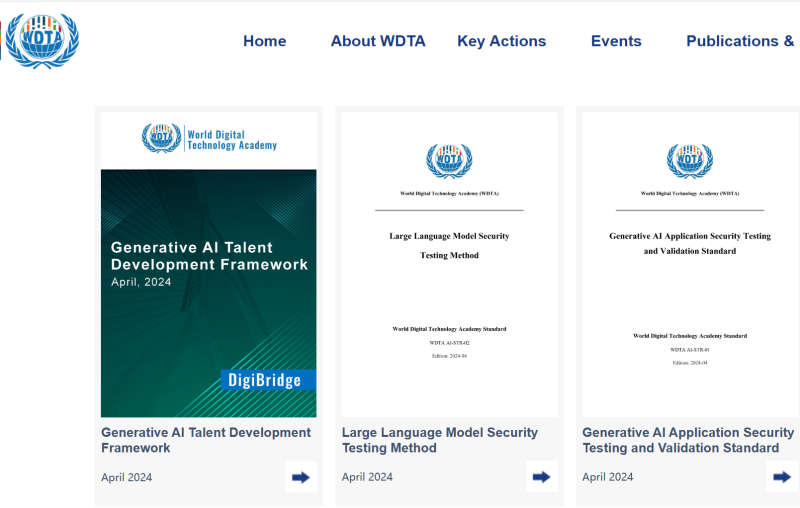
Two standards and a development framework issued by the World Institute of Digital TechnologyThe file picture is from official website, the World Institute of Digital Technology.
China enterprises actively participate in international standards.formulate
The reporter of Shell Finance noticed that there were many face of china during this meeting. For example, in the panel discussion on "Safety of Generative Large Model", experts from Canadian Academy of Engineering, Privacy AI, NVIDIA, Microsoft and Ant Group talked on the same stage.
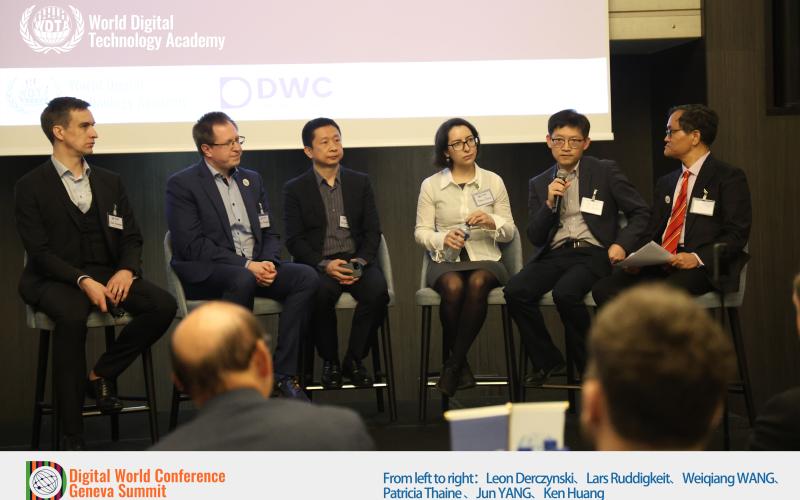
Chinese and foreign experts participate in the large-scale model safety panel discussion. Photo from official website, World Institute of Digital Technology.
In fact, the two international standards released this time were compiled by many experts and scholars from OpenAI, Ant Group, Iflytek, Google, Microsoft, NVIDIA, Baidu and Tencent.
Among them, Ant Group is the lead unit for the Safety Testing Method of Large Language Model. This standard provides a comprehensive, rigorous and practical structural scheme for the safety evaluation of the large model itself. It puts forward the security risk classification of large language model, the classification and grading method of attacks and the testing method, and takes the lead in giving four classification standards of attack methods with different attack intensities, providing strict evaluation indexes and testing procedures, which can solve the inherent complexity of large language model, comprehensively test its ability to resist hostile attacks, enable developers and organizations to identify and alleviate potential vulnerabilities, and ultimately improve the security and reliability of artificial intelligence systems built using large language models.
As a representative of the standard participating units, Wang Weiqiang, general manager of the machine intelligence department of Ant Group and chief scientist of Ant Safety Laboratory, said, "With the rise of generative artificial intelligence, we believe that it will release huge productivity, but it will also bring various new risks. Be highly vigilant. Large technology companies should play a key role in promoting the safe and responsible development of generative artificial intelligence, use their resources, expertise and influence to promote best practices, and build an ecosystem that gives priority to safety, privacy and moral considerations. For example, by formulating industry standards and guidelines, it provides clear guidance for developers and institutions to develop and deploy generative artificial intelligence systems; Invest in research and development and open tools to ensure the safety of generative artificial intelligence to form industrial co-governance. "
Shell Finance reporter found that at present, mainstream manufacturers at home and abroad are focusing on the safety of large models. For example, OpenAI invested 20% of computing resources in four years and set up a special team to build solutions.Alignment problemSuper AI, Google and other 12 organizations jointly released the "Model Safety Assessment Framework", NVIDIA launched the "guardrail" software to prevent the AI model from getting out of control, while 360 and Chianxin released the safety big model and launched the business for the safety of the big model.
The release of the two international standards provides a unified testing framework for the industry.
"The development of these two standards brings together the wisdom of experts in the global AI security field, filling the gap in the field of security testing in large language models and generative AI applications. They provide clear testing requirements and methods for AI enterprises, help to improve the security of AI systems, reduce potential risks, promote the responsible development of AI technology and enhance public trust. Call on the industry to actively adopt these two standards, work together to improve the security and reliability of AI systems, and participate in the standard formulation of WTDA AI STR, and constantly improve the standards in the process of rapid iteration of AI technology. " Huang Jinlin said.
Reporter contact email: luoyidan@xjbnews.com
Beijing News Shell Financial Reporter Luo Yidan
Editor Ding Shuang
Proofread Wang Xin