Strong institutional advantages of basic people’s livelihood security are fully demonstrated —— Interpretation of main economic data in 2020 by relevant officials of the National Bureau of Statistics


In 2020, in the face of the sudden COVID-19 epidemic, China’s economy recovered rapidly after the impact at the beginning of the year, and embarked on an exciting rebound curve. Various economic indicators turned from negative to positive, which confirmed the steady progress of China’s economy. At the same time, the indicators of people’s livelihood have also been continuously improved: the number of new jobs in cities and towns in the whole year was significantly higher than the expected target; The urban consumer market continued to improve; The per capita disposable income of residents is basically synchronized with economic growth. In 2020, the per capita income of national residents will double that of 2010.
Steady recovery of investment and continuous optimization of structure
Director of Investment Department Zhai Shanqing
In 2020, the growth rate of fixed assets investment rose steadily, the structure continued to be optimized and the recovery trend continued to be consolidated.
First, the growth rate of investment continued to rise.
Affected by the COVID-19 epidemic, the national investment in fixed assets dropped by 24.5% from January to February in 2020, and then the decline narrowed month by month, falling by 3.1% in the first half of the year, and the growth rate turned from negative to positive in the first three quarters. The annual investment increased by 2.9% over the previous year, and the growth rate was 0.3 and 2.1 percentage points faster than that from January to November and the first three quarters respectively.
The growth rate of investment in the four major regions all turned positive. In 2020, the investment in the eastern region will increase by 3.8% over the previous year, the investment in the central region will increase by 0.7%, and the investment in the western and northeastern regions will increase by 4.4% and 4.3% respectively.
The three industrial investments all achieved positive growth. In 2020, the investment in the primary industry will increase by 19.5%, the investment in the secondary industry will increase by 0.1% and the investment in the tertiary industry will increase by 3.6%.
Second, investment in the three major areas continued to improve.
Infrastructure investment grew steadily. In 2020, infrastructure investment will increase by 0.9% over the previous year. Among them, investment in information transmission industry increased by 16.0%, investment in ecological protection and environmental management industry increased by 8.6%, investment in water conservancy management industry increased by 4.5%, and investment in road transportation industry increased by 1.8%.
The decline in manufacturing investment continued to narrow. In 2020, manufacturing investment decreased by 2.2% compared with the previous year. Investment in raw material manufacturing industry increased by 2.1%, among which investment in ferrous metal smelting and rolling processing industry increased by 26.5%, and investment in oil, coal and other fuel processing industries increased by 9.4%.
Investment in real estate development increased rapidly. In 2020, investment in real estate development increased by 7.0% over the previous year. Among them, residential investment increased by 7.6%, the funds in place of real estate development enterprises increased by 8.1%, and the newly started housing area of real estate development enterprises decreased by 1.2%.
Third, the growth rate of private investment has accelerated.
In 2020, private investment increased by 1.0% over the previous year. Among them, private investment in agriculture, forestry, animal husbandry and fishery increased by 13.5%, private investment in real estate development increased by 6.8%, and private investment in infrastructure and manufacturing narrowed by 0.8 and 1.5 percentage points respectively.
From a regional perspective, private investment in the eastern region increased by 1.2%, private investment in the central region decreased by 2.4%, and private investment in the western and northeastern regions increased by 4.8% and 3.5% respectively.
Fourth, the investment in high-tech industries has a significant pulling effect.
In 2020, the investment in high-tech industries increased by 10.6% over the previous year, driving the total investment to increase by 0.8 percentage points. Investment in high-tech manufacturing industry increased by 11.5% and investment in high-tech service industry increased by 9.1%.
V. Rapid growth of investment in people’s livelihood.
In 2020, investment in social fields increased by 11.9% over the previous year. Among them, education investment increased by 12.3% and health investment increased by 29.9%.
With the support of proactive fiscal policy and prudent monetary policy, the investment funds in place in 2020 will increase by 7.8% over the previous year, of which the growth rate of national budget funds is as high as 32.8%, and sufficient funds provide an important guarantee for the gradual recovery of investment. In 2020, the planned total investment of newly started projects will increase by 11.9%, which is 10.8 percentage points faster than the previous year. The rapid growth of the planned total investment of newly started projects will bring good support to the investment growth in 2021.
Consumption continued to recover, and the retail market picked up.
Dong Lihua, Director of the Department of Foreign Trade and Economic Cooperation
In 2020, the strategy of expanding domestic demand and various policies to promote consumption will be effective, market sales will improve quarter by quarter, and business model innovation and consumption structure upgrading will continue to develop.
First, the market sales continued to pick up, and the recovery of consumption was gradually consolidated.
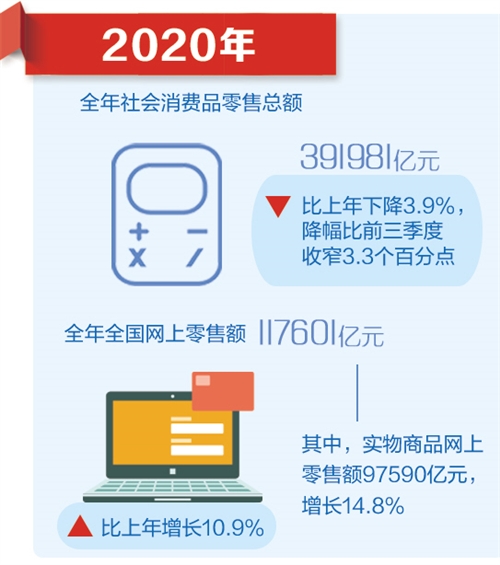
Market sales are improving quarter by quarter. In 2020, the total retail sales of social consumer goods was 39,198.1 billion yuan, down 3.9% from the previous year, and the decline was 3.3 percentage points narrower than that in the previous three quarters. Market sales show a quarterly recovery trend. In the first quarter, the consumer market was obviously hit by the epidemic, and the market sales dropped by 19.0%. In the second quarter, the decline in market sales was obviously narrowed, and the growth rate in the third quarter turned positive for the first time. In the fourth quarter, the total retail sales of consumer goods increased by 4.6% year-on-year.
The recovery of the consumer market continued. In December 2020, the total retail sales of social consumer goods continued to grow, and the market sales increased positively for five consecutive months.
Second, the urban and rural markets recovered quarter by quarter, and the rural market recovered better than the urban market.
The urban consumer market continued to improve. In 2020, the retail sales of urban consumer goods decreased by 4.0% over the previous year. The growth rate of rural consumer goods market is higher than that of cities and towns. In 2020, the retail sales of rural consumer goods decreased by 3.2% over the previous year. Among them, the retail sales of rural consumer goods increased by 5.6% in the fourth quarter.
Three, the retail scale of goods is close to the level of last year, and the consumption of catering and other services continues to recover.
Retail sales of goods recovered quickly. In 2020, the retail sales of commodities decreased by 2.3% compared with the previous year, and the decline rate was 2.8 percentage points narrower than that of the previous three quarters, and the retail sales scale of commodities was close to that of the previous year. Judging from the recovery process of commodity retail sales, the monthly scale of commodity retail sales has recovered to the same level as early as July, and the recovery speed is faster than the overall level of the consumer market, and it has been growing positively for six consecutive months.
Accommodation and catering business improved. In 2020, the catering revenue decreased by 16.6% compared with the previous year, and the decline was 7.3 percentage points narrower than that in the previous three quarters. Among them, the catering revenue in the fourth quarter increased by 0.2% year-on-year, and the scale of the catering market in the quarter returned to the same level of the previous year.
Fourth, the development of new consumption patterns has accelerated, and the consumption of physical stores has improved significantly.
Online consumption grew rapidly. Affected by the epidemic, the demand for home consumption has increased significantly, and the "home economy" has accelerated the development of new consumption patterns. In 2020, the national online retail sales increased by 10.9% over the previous year.
Offline consumption has improved significantly. In 2020, the retail sales of goods in supermarkets above designated size increased by 3.1% over the previous year, and the decline of retail sales of department stores, specialty store and specialty stores narrowed by 6.8, 3.8 and 5.4 percentage points respectively compared with the previous three quarters.
Five, the retail momentum of upgraded goods is improving, and the automobile sales market is obviously picking up.
The retail performance of upgraded goods is bright. In 2020, the retail sales of consumption-upgrading commodities such as cultural office supplies, sports and entertainment supplies, cosmetics and communication equipment of units above designated size will increase by 5.8%, 8.4%, 9.5% and 12.9% respectively over the previous year, and the growth rate is significantly higher than the average level of commodity retail.
The scale of automobile sales is close to the level of last year. In 2020, the retail sales of automobile products above designated size decreased by 1.8% compared with the previous year, and the scale was close to the previous year’s level. Especially since the second half of the year, the retail sales of automobile products have maintained rapid growth for six consecutive months.
The employment situation improved and the expected goal was achieved.
Zhang Yi, Director of Population and Employment Statistics Department
In 2020, under the impact of the epidemic in COVID-19, employment faced enormous pressure that had not been seen for many years. With the implementation of a series of policy measures to reduce burdens, stabilize posts and expand employment, the employment situation gradually stabilized and improved, and the expected employment objectives and tasks were successfully completed.
First, the national urban survey unemployment rate continued to fall, and the employment situation gradually improved.
Under the impact of the COVID-19 epidemic in early 2020, economic activities were restricted, enterprises stopped production, and the job market was obviously affected. In February, the national urban survey unemployment rate rose to a high of 6.2%. With the continuous promotion of resumption of work, the urban survey unemployment rate dropped to 5.7% in June.
In the second half of the year, the social production and living order was further restored, and the unemployment rate dropped to 5.4% in September. In the fourth quarter, the employment situation further stabilized and improved. In December, the unemployment rate dropped to 5.2%, which was the same as the same period in 2019.
Second, the employment pressure of migrant workers has gradually eased, and the overall employment situation of college graduates is stable.
At the beginning of 2020, the employment situation of migrant workers was once very severe. At the end of February, the number of migrant workers in rural areas decreased by 54 million compared with the same period of last year. In March, the unemployment rate of migrant agricultural registered population in cities and towns reached an all-time high of 6.7%. By the end of the year, the number of migrant workers had recovered to 97.3% of the previous year, and the unemployment rate of migrant agricultural registered population in cities and towns was basically the same in December.
In 2020, the number of college graduates in China will reach 8.74 million, a record high. With the impact of the epidemic, the employment pressure is very prominent. In July, the unemployment rate of urban people aged 20 to 24 with college education or above (mainly college graduates) increased by 3.3 percentage points year-on-year. Various regions and departments actively broaden the employment channels of college graduates, the employment situation of college graduates gradually improves, and the unemployment rate tends to decline. In December, the unemployment rate of people aged 20 to 24 with college education or above dropped by 7.2 percentage points compared with July, which was the same as the same period in 2019.
Third, comprehensively strengthen the employment priority policy, and successfully achieve the expected employment goals.
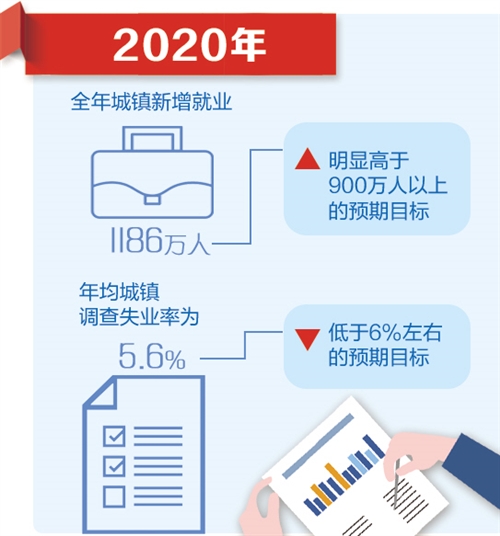
Since 2020, all localities and departments have solidly promoted the work of stabilizing employment, reduced taxes and fees on a larger scale to reduce the burden on enterprises, lifted unreasonable restrictions on flexible employment, encouraged entrepreneurial innovation to promote employment, highlighted the employment of key groups, vigorously carried out vocational skills training, comprehensively strengthened various employment services, and promoted the smooth completion of various employment expectations. In 2020, the national average annual urban survey unemployment rate will be 5.6%, which is lower than the expected target of around 6%; In 2001, the number of new jobs in cities and towns was 11.86 million, 2.86 million more than the expected target of 9 million. At the end of the year, the registered urban unemployment rate was 4.24%, which was lower than the expected target of about 5.5%.
In 2020, China has withstood the severe test of the epidemic, and the employment situation has gradually stabilized and improved under great pressure. In 2021, the epidemic situation and external environment are still facing uncertainties, but with the support of a solid economic foundation and sufficient policy tools, the national economy will further recover steadily and the employment situation is expected to remain generally stable.
Income growth promotes the growth of people’s livelihood expenditure
Fang Xiaodan, Director of Household Survey Office.
In 2020, the per capita disposable income of the national residents will double that of 2010; The income of rural residents continued to grow faster than that of urban residents, and the income gap between urban and rural residents further narrowed. Residents’ consumption expenditure has steadily recovered, and basic people’s livelihood expenditure has grown steadily.
1. In 2020, the per capita income of the national residents will double that of 2010.
Residents’ income growth is basically synchronized with economic growth. In 2020, the per capita disposable income of the national residents was 32,189 yuan, a nominal increase of 4.7% over the previous year. After deducting the price factor, the per capita disposable income of the national residents actually increased by 2.1%.
In 2020, the per capita income of the national residents will double that of 2010. After deducting the price factor, from 2011 to 2020, the per capita disposable income of the national residents increased by 7.2% annually in real terms, with a cumulative real increase of 100.8% in 10 years.
The relative income gap between urban and rural residents has further narrowed. The income of rural residents continues to grow faster than that of urban residents. In 2020, the per capita disposable income of rural residents will be 17,131 yuan, and that of urban residents will be 43,834 yuan.
Second, the growth rate of various incomes rose steadily, and the policy of ensuring employment and people’s livelihood continued to be effective.
Employment protection measures have been effective and promoted the growth rate of wage income to rebound. In 2020, the per capita wage income of the national residents will be 17,917 yuan, an increase of 4.3%.
In 2020, the per capita net transfer income of national residents was 6,173 yuan, an increase of 8.7%. The basic pension standard for urban and rural residents has been raised, and the per capita pension or retirement pension of the whole country has increased by 7.8%.
The better agricultural production situation has prompted the net operating income to increase from decline. In 2020, the per capita net operating income of the national residents was 5,307 yuan, and the growth rate of per capita net operating income turned positive.
3. Residents’ consumption expenditure recovered steadily, and basic people’s livelihood expenditure grew steadily.
The decline of residents’ consumption expenditure narrowed quarter by quarter, showing a sustained recovery trend. In 2020, the per capita consumption expenditure of the national residents will be 21,210 yuan, down by 1.6% over the previous year.
Basic livelihood expenditure continued to grow steadily. In 2020, the per capita commodity consumption expenditure of residents was 12,173 yuan, an increase of 4.3%. Affected by the increase in home time, the per capita expenditure on food, alcohol and tobacco and the per capita expenditure on housing increased by 5.1% and 3.2% respectively.
The level of consumption expenditure such as health communication has risen, and the per capita expenditure on medical alcohol, masks and other medical and health appliances has increased by 2.0 times. Residents’ communication needs have increased, and online shopping behavior has increased substantially. In 2020, the per capita communication service expenditure of the national residents will increase by 6.2%.
The ownership of durable consumer goods continues to increase. In 2020, the number of family cars owned by every 100 households in China was 37.1, an increase of 5.2% over the previous year; The number of mobile phones per 100 households was 253.8, an increase of 0.2%.
Prices gradually fell, and production prices rebounded.
Wang Youfen, Director of Urban Department
In 2020, the relationship between supply and demand in the market will continue to improve, CPI will gradually fall from the high point, PPI will rise steadily from the low point, and the price trend will be basically stable throughout the year.
First, the price increase in the consumer sector has dropped.
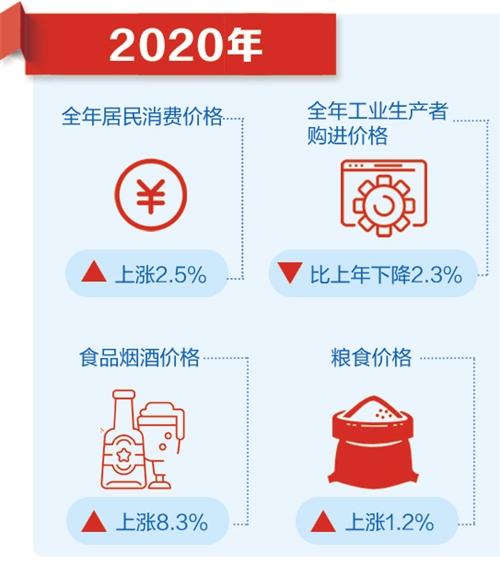
The monthly CPI is higher than before and lower than before. In 2020, CPI rose by 2.5%, down 0.4 percentage points from the previous year. In terms of months, the year-on-year trend was generally high before and low after. In the first two months, affected by the COVID-19 epidemic, the "pig cycle" and the Spring Festival, the prices of pork and other foods rose rapidly, driving the CPI to rise more, up 5.4% and 5.2% respectively. The increase of CPI began to fall in March, and CPI continued to fall in August, and it turned down by 0.5% in November. In December, CPI rose by 0.2% due to factors such as low temperature weather, increased demand and rising costs.
Food prices have increased considerably. In 2020, food prices rose by 10.6%, an increase of 1.4 percentage points over the previous year, which affected the increase of CPI by about 2.2 percentage points, which was the main factor to promote the increase of CPI. In food, the price of pork rose by 49.7%, an increase of 7.2 percentage points over the previous year, which affected the increase of CPI by about 1.6 percentage points, accounting for more than 60% of the total increase of CPI. The price of fresh vegetables rose by 7.1% in the whole year, which affected the increase of CPI by about 0.18 percentage points. Affected by the high comparison base in the same period of last year, the prices of fresh fruit and eggs decreased by 11.1% and 10.8% respectively, which affected the CPI by about 0.27 percentage points.
The overall change of non-food prices is small. In 2020, non-food prices rose by 0.4%, down by 1.0 percentage points from the previous year, affecting the CPI increase by about 0.28 percentage points. Among non-food products, due to weak demand and lower international crude oil prices, the price of industrial consumer goods changed from 0.6% in the previous year to 0.8%.
Second, prices in the production sector rebounded at a low level.
The overall PPI fell first and then rose. In 2020, the PPI decreased by 1.8%, an increase of 1.5 percentage points over the previous year. By month, due to the epidemic situation and other factors, the demand for industrial products was sluggish at the beginning of the year, and the PPI entered a downward range from February to February. As the domestic epidemic prevention and control situation continues to improve, the PPI has stopped falling and turned up since June, and the year-on-year decline has steadily narrowed. In December, PPI rose by 1.1% month-on-month, the biggest increase since January 2017, down by 0.4% year-on-year.
Prices of related industries such as oil, steel and coal fell. In 2020, the prices of domestic oil-related industries generally declined due to factors such as the fluctuation of international crude oil prices and the epidemic situation. The prices of oil-related industries, such as oil and gas exploration, oil, coal and other fuel processing, chemical raw materials and chemical products manufacturing, chemical fiber manufacturing and so on, dropped by an average of 5.9% to 27.4% in the whole year, which affected the PPI by about 1.27 percentage points, accounting for 70% of the total PPI decline.
Prices of other major industries have gone up and down. In 2020, the price of agricultural and sideline products processing industry will increase by 4.8% due to the price increase of livestock slaughter, vegetable oil processing and feed processing; The prices of culture, education, industry, sports and entertainment products manufacturing, wine, beverage and refined tea manufacturing, medicine manufacturing and food manufacturing rose between 0.6% and 3.3%. The total impact of the above five industries on PPI rose by about 0.36 percentage points. The price of equipment manufacturing industry is generally stable.
Source: Economic Daily