[Li Xiang Highlights] ① | Thinking about a photo-recalling the big photo on the front page of People’s Daily 40 years ago
Today is my festival again, commemorating the climax of rural reform.
November 7th is to commemorate the 90th anniversary of the establishment of Xinhua News Agency, the 8th is China Journalists’ Day, and today is November 9th, which is another festival for me.
I have been a journalist for most of my life, and then I did theoretical things, leaving many memorable days. Since 1979, my initial period of prosperity has been about five years, and many reports have aroused great repercussions throughout the country, such as "crossing the Dadu River", "breaking through the Wujiang River" and "capturing Lazikou" in my life. News works are like milestones, marking the road I have traveled.
The first peak of my life appeared in December 1981. This time, at the National Work Conference of Xinhua News Agency, Mu Qing, President of Xinhua News Agency, praised me as a "good reporter for the people" at the conference. After that, Deng Xiaoping, Hu Yaobang and Hu Jintao praised me many times. Of course, the first praise was from President Mu Qing, which impressed me even more.
Confucius said, "Stand at 30", stand upright, make a statement, make meritorious deeds and stand upright. When Mu Qing praised me as a "good reporter sealed by the people", I was less than 30 years old.
Today, a photo aroused imagination. This is also related to an encounter with his wife, which will be mentioned later in the article.
A symbol of the beginning of rural reform
For more than ten years after 1966, the front page of People’s Daily was a photo of Chairman Mao. It’s not easy for the workers and peasants. Especially the front page headlines. However, after 1978, this habit was broken.
On December 17, 1979, my photo "Joy of Cotton Girl" was published in the People’s Daily, which echoed the spirit of the Fourth Plenary Session of the Eleventh Central Committee at that time, and it was the first news photo to fulfill the policy after the Third Plenary Session of the Eleventh Central Committee, and it made headlines.

In fact, since November 1978, newspapers have only begun to use personal names, just one year. After more than ten years of the Cultural Revolution, there was no personal signature, and I caught up with a good time. At that time, Economic Daily was not founded, Workers Daily and China Youth Daily were not reissued, and there were very few journalists. People’s Daily had a great influence. This photo was rated as the first-class draft of the first rural picture after the reform and opening up of Xinhua News Agency. That year, Xinhua News Agency just started to evaluate the draft.
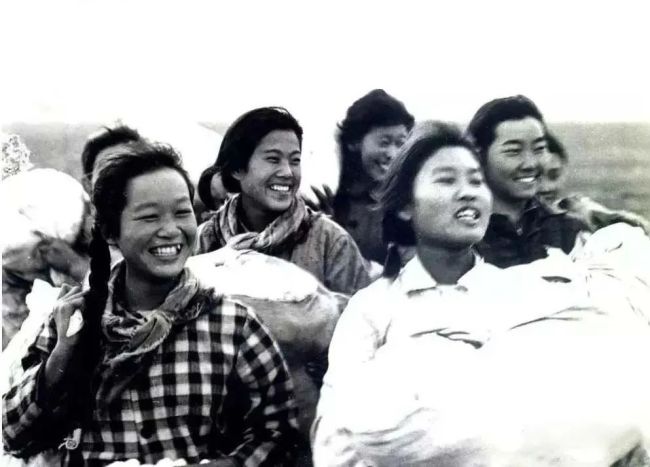
40年后,这张照片出现在天安门广场右侧的中国革命历史博物馆里,成为新华社1979年的代表作。去年,在中国共产党党史馆里,农村改革也是以这幅照片为标志,上面一张是邓小平和万里在谈农村改革,后面就是我这幅照片。小岗村按手印那一幅照片曾经是农村改革的象征。后来那幅照片很少出现。我的《棉花姑娘的喜悦》便成为标志了。

到了1981年,我的照片在人民日报上越来越多了,一年登了24张,我是全国第一名,第二名是安徽的记者徐光春。
就在头版头条发表的一个月前的10月5号,人民日报登了我的《冒尖户王本跃和他的书记朋友》。当时新任国务院副总理万里对一个农业副部长说“你是做人民的敌人还是做人民的朋友?”当场责问这位农业部长。我并不知道上面的事,但是我的标题与这场争论相呼应。当时,穆青讲了“要表扬”,而且穆青讲,中午吃饭的时候和他的老伴续磊讲,“你看这张照片拍的多好,那驴子长得多精神”。吃饭都在和老伴议论,可见社长对这张照片的喜爱。
On November 9, 1981, People’s Daily published my big photo on the front page.
If the photo "The Joy of Cotton Girl" is a symbol of the beginning of rural reform. In November 1981, after the cotton harvest in northwest Shandong, the headline in the photo was a symbol of the climax of rural reform. At this stage of the economic situation, there has been a "tug-of-war" state, and some people support it and make a hullabaloo about; Some people are against it, but they are screaming at the top of their lungs. It seems that the decisive battle between socialism and capitalism is at stake.
On November 9, 1981, the cotton harvest in northwest Shandong reached a climax, and the People’s Daily appeared news photos of rural grass-roots units on the front page, which is rare. In the ten years of turmoil, it is impossible to make headlines except for the large photos of leaders, industrial and agricultural production and economic photos. This is obviously a sign of news reform.
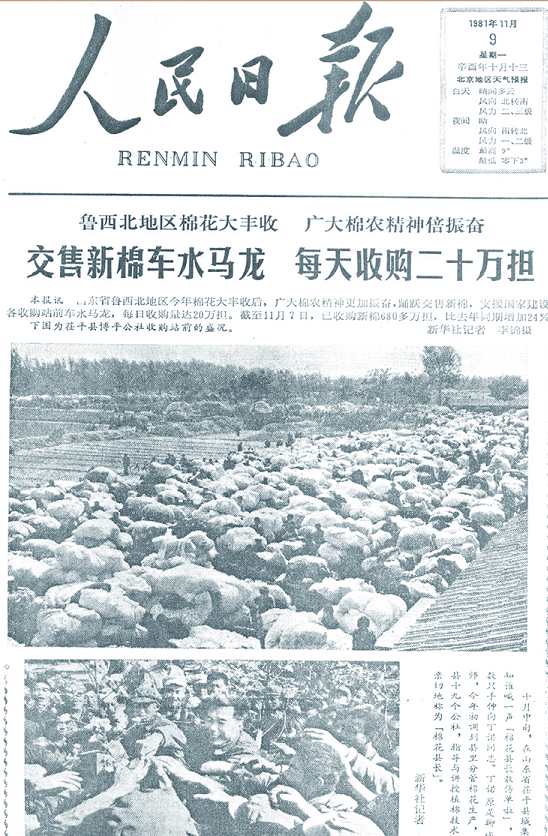
On this day, I remember that on the way from the "Kouzi Building" to the No.6 Building of Xinhua News Agency, Mr. Jiang Qisheng saw me and said, "This morning, the news and newspaper summary program of China Central Radio made the front page headlines, without saying the name. Is it you?"
Mr. Jiang Qisheng listened to the report of China Central Radio. On the morning of November 9, 1981, the news and newspaper summary program in china national radio introduced the news that "the cotton harvest in northwest Shandong Province buys 200,000 tons every day". I haven’t seen the newspaper yet, and I’m not sure. I said, "I sent such a manuscript."
I haven’t been in the office for a long time, so the newspaper came. I saw these two photos of People’s Daily. In the first edition of People’s Daily, the editor directly changed the picture description into a short message, and put the photo on the front page, which was nearly 20 cm long and 12 cm wide, plus a leaflet of Mian County, occupying a quarter of the whole page.
The leaflet of Cotton County Magistrate was distributed a few days ago. All the photos sent by Xinhua News Agency were put in the frame in the editor-in-chief room of People’s Daily. It was the editor who put the two photos together and became a headline news. Editors are very attentive.
I saw this newspaper myself, and it was a shocking feeling, which I never dreamed of.
Let me have a look. The whole editorial department is staring at me. I’m sorry to see my face burning. They said, "Xiao Li, another gold ingot", "another shell" and "another satellite". I whispered "bump into". At this time, Yuan Ling said, "You met all the good manuscripts, but others didn’t. You worked hard."
At 10 o’clock, Sun Zhen, a member of the party group and director of the photo department of Xinhua News Agency, conveyed Mu Qing’s words. "Mu Qing said that we should praise Li Jin", and I don’t know anything else. What I remember is this sentence "Li Jin wants to praise".
People regard photo reports and photographers with special respect.
In the large-scale changes of the national agricultural production system, the northwest of Shandong Province was still in the lead in 1981, which was particularly eye-catching. Because it is one to one and a half years earlier than most areas in China, the situation is developing rapidly and with sufficient momentum. Heze, Liaocheng, Dezhou and Huimin are connected together, which is the largest area closest to the capital Beijing where the household contract responsibility system is implemented at this time. Wan Li transferred to Beijing, Anhui situation reversed. The whole country looks at Shandong, and Shandong looks at the northwest of Shandong.
In the autumn of 1981, there was a bumper harvest of cotton in northwest Shandong, and I came to Chiping County again.
"Oh, that cotton is like the sea!" Yang Chaoguo, secretary of Boping commune who cooperated with me for many times, vividly introduced me to Boping cotton purchasing station. I arrived in chiping this morning, and in the afternoon, 13 people came to the hostel to find me, most of whom were acquaintances contacted in the report. I suggested that I should take a photo of the big scene of cotton harvest, leaving behind the grand occasion of China’s implementation of "household production quotas" in the 1980s, and asked my friends to look at the scene separately for me.
Finally, the cotton collection station of Boping commune was selected. The people here are the most concentrated and imposing, and there are more than 400 cotton-handed cars under their eyes, forming a sea of cotton flowers. In the distance is a three-or four-mile-long cotton crossing team that forms a curve. I have never seen such a spectacular scene, and it has never appeared in the newspaper.
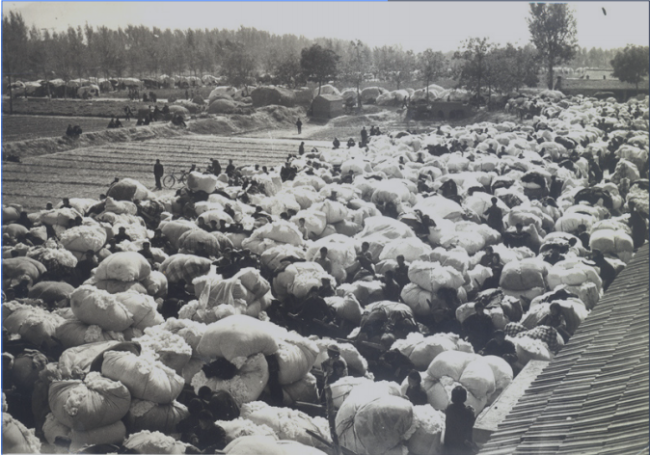
Cotton farmers sell cotton, which is everywhere.
For a long period of time, China newspapers used pictures as newspaper pictures, which made it difficult for pictures to play their unique functions. Except for the ten years of turmoil, the leader’s portrait was once placed in a prominent position, and the photos of ordinary people’s lives were not placed in the front page. This unusual handling by the editor-in-chief of People’s Daily made this group of pictures become the symbol of China’s news reform, which aroused strong repercussions in the press.
When the press in China first selected the excellent layout, it was awarded the National Excellent Layout Award for Good News in 1981. Jiang Qisheng, president of China Press Photography Society, said that Li Jin’s headline photo made people look at photo reports and photographers differently.
The front page headlines, the sensation of big photos.
People’s Daily and Xinhua News Agency cooperate very closely. Later, I heard that when the newspaper arrived that day, the Central Committee was in a meeting. Comrade Chen Yun said, "What do you think of the situation? Take a look at the newspaper. " At that time, I heard that it was a newspaper I read during the break of the meeting.
On the third day, this matter continued to ferment in Beijing. On November 11th, People’s Daily published Fang Ji’s article in the first edition of Today’s Talk, commenting on this headline, titled "Praise the Headline of Pictures". The content is as follows:
On November 9th, People’s Daily took pictures as the front page news, reflecting the gratifying scene of another bumper harvest of cotton in northwest Shandong this year. Seeing the overwhelming cotton and the flood of vehicles for sale, can we not applaud the farmers in northwest Shandong for making "cotton wealth" again?
News should be "new" and stress timeliness; To live, vivid and attractive, be clear at a glance. A good picture, placed in the headline position, broadens readers’ horizons and arouses the common concern of the society, which is more wonderful than words can express. In my memory, this is an innovation in the news arrangement of our newspaper. People have seen the power of the party’s policies and science and technology from the long queue of cotton sales. The state-owned policy of enriching the people, the people’s patriotic actions, making a fortune and patriotism are integrated.
This report was encouraged by Xinhua News Agency and some old comrades in the press. Comrade Xu Guangchun pointed out in an article at that time: In November 1981, a group of photos of "Cotton Harvest in Northwest Shandong" shot by Li Jin of Shandong Branch issued by Xinhua News Agency can be said to be the product of the combination of journalists’ news sensitivity and image sensitivity. The strong news and persuasiveness of photos cannot but make people admire the reporter’s news sensitivity. But this alone is not enough. While grasping the news, journalists have mobilized their image sensitivity. In the process of shooting, the vivid scenes of cotton farmers selling new cotton and "cotton county magistrate" scattering leaflets were chosen respectively, which contained profound news themes in vivid images and made the photos new, deep and vivid. People’s Daily published this group of photos in the front page.
Because at this time, the 50th anniversary of the establishment of Xinhua News Agency, Li Zhen, secretary of Shandong Provincial Party Committee, came to Xinhua News Agency and said that "Xinhua News Agency has made great contributions to rural reform", taking this photo as an illustration.
In November 1981, this big photo and large layout became an important symbol of the success of rural reform in China, which was remembered by history.
Mu Qing praised me as a "good reporter sealed by the people"
At this stage, the big photo on the front page brought me great reputation.
Just over a month ago, Mu Qing praised me as a "good reporter named by the people". It should be said that it is related to four things.
One thing is that in 1981, Xinhua News Agency commented on 24 articles, and I was the first in the whole Xinhua News Agency. This was spelled out one by one.
The second thing is the sensation on the front page of People’s Daily.
The third thing, I rode my bike to six counties in the northwest of Shandong, went down from Jinan, passed Qihe, Yucheng, Xiajin, Pingyuan and Lingxian, and rode alone for thousands of miles.
The fourth thing is that six counties in northwest Shandong wrote letters of praise, including the saying that "the peasant family is a good reporter." Later, I learned that Shi Haoquan, Tian Nairen, Zhang Baohai and others wrote these letters.
These four things, from the works, social influence, interview style and the evaluation of the masses, came to Beijing in waves, and President Mu Qing praised me under such circumstances.
I remember that day was December 31st.
When Comrade Mu Qing was talking, he stopped suddenly. "Who is Li Jin? Stand up. " I was burying my head in taking notes when the editor sitting next to me touched me. I quickly stood up and the whole audience stared at me and stopped for a few seconds.
Mu Qing although a wave, "sit down". At this time, Mu Qing said, "Li Jin won glory for Xinhua News Agency, made contributions and brought honor. Who proposed his’ good reporter from the peasant family’ and was sealed by the people."
In our Xinhua News Agency, we talk about Mu Qing’s name just as people talk about the emperor. Mu Qing’s praise, and this kind of super-standard praise, is rare for others. I sat down in a tremendous shock.
It has been 40 years since this incident. As time goes by, many things are forgotten. Some books published later were also recorded.
On the road, my lover happened to meet the owner of the headline 40 years ago.
A few days ago, when I was in Yimeng Mountain, my wife took her daughter to Qingdao to recuperate. On the way, I met an old man with white hair who was also recuperating. He was the leader of the Agriculture Department of Shandong Province. Because he didn’t want to go far away, for fear of causing trouble to others, my wife started Lei Feng again, helped the 93-year-old man get on the bus and sent him home when he came back. He suddenly asked his daughter, "which unit is your father from?" My daughter said, "Xinhua News Agency".
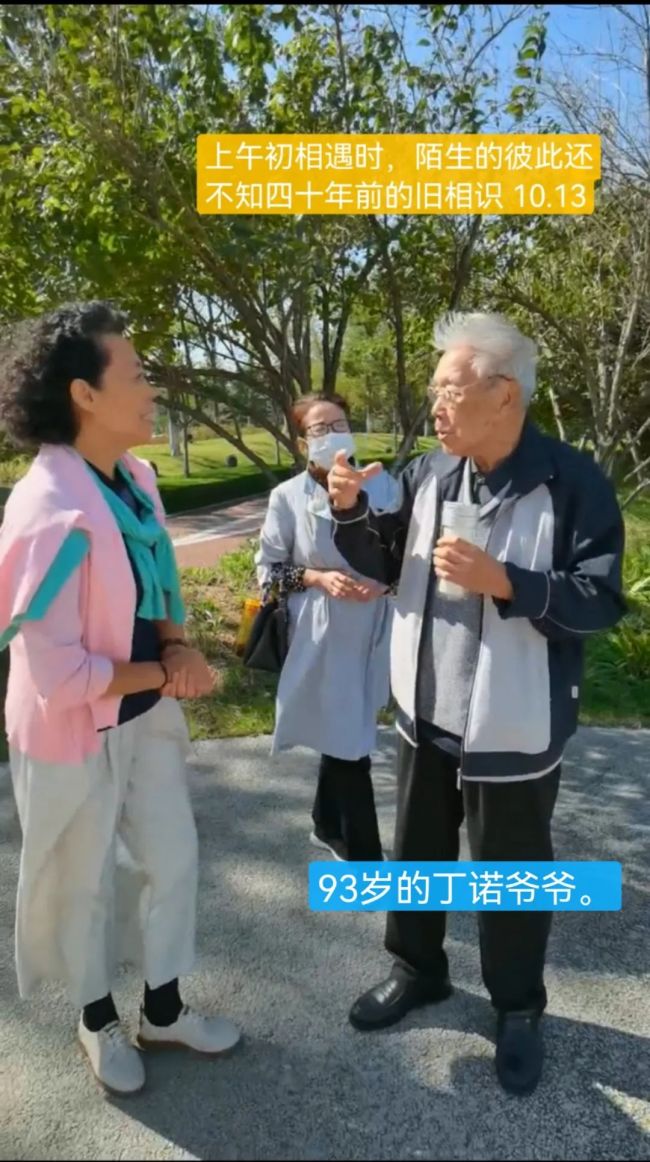
Li Haiping, his wife, and Li Mian, his daughter, met Ding Nuo in Qingdao Sanatorium. My daughter sent this to me that day.
The old man turned and muttered, "Xinhua News Agency, Li Jin. Li Jin, Xinhua News Agency ".
My daughter heard the old man muttering to herself and asked him, "Grandpa, who are you talking about?"
At this time, the old man’s daughter said, "Li Jin, Muzi Li, the icing on the cake. Dad often talks about this person. When he talks about Xinhua News Agency, he talks about Li Jin. "
My daughter asked, "Is it Li Jin in Shandong Branch of Xinhua News Agency?"
The old man stared at my daughter and said, "yes, that’s him. I’ll never forget it."
The old man’s daughter said that on November 9, 1981, his photo was published on the front page of the People’s Daily, and his name was "Mianhua County Magistrate’s Leaflet". He said it once every few days.
My daughter said with surprise and excitement, "Grandpa, I am Li Jin’s daughter. The one who helped you just now is Li Jin’s daughter-in-law."

On October 13th, my daughter, Li Mian, was with Ding Nuo, listening to my grandfather’s story about being beaten as a rightist and bumping into me.
At this time, the old man quickly waved. My wife Li Haiping came up and said, "Are you the wife of Li Jin? Li Jin is a good reporter. "
The old man talked about the situation in 1981. At first, he was a rural technician. He once became a rightist and worked as a teacher in Liaocheng Agricultural School. Later, he worked as the deputy director of the Revolutionary Committee in Chiping County. Go to Chiping County to catch cotton production. He went to the market to publicize the cotton planting technology of Lumian No.1.. At that time, we relied on policy, science and heaven for help.
I mean, the leaflet of Mianhua county magistrate reflects the background that the focus of the whole party’s work has shifted from large-scale mass political movements and class struggles to production and construction, which is a change of the times.
This leaflet photo was captured on the spot. On that day, I went to the market with Ding Nuo, who is known as the "cotton county magistrate", to teach the people about cotton planting. After class, a farmer who was familiar with Ding Nuo said, "I can’t hear all you said, and I can’t remember it. My mother also wants to listen to your class, so I don’t have time to come." You bring me a piece of clear paper. "
Ding Nuo drew a copy from the science and technology leaflet to be sent to the member and handed it to the member. I didn’t expect this leaflet to be picked up, but it was cut off halfway. Dino took out another one, ready to hand it over. Suddenly, dozens of hands reached out to him, and the crowd shouted "Give me one", "Ding Caishen, give me one" and "Mian County, I want one". The scene was extremely warm.
I wanted to take a photo, but I was pushed aside by the crowd who asked for a flyer. When I was in a hurry and couldn’t take a photo, a young man grabbed the flyer with a bicycle. I pulled his handlebar and said, don’t move, I’ll ask for one for you later. He watched me quickly climb onto the back of my bike, pressed the shutter three times in a row, and then I was knocked down by the crowd.
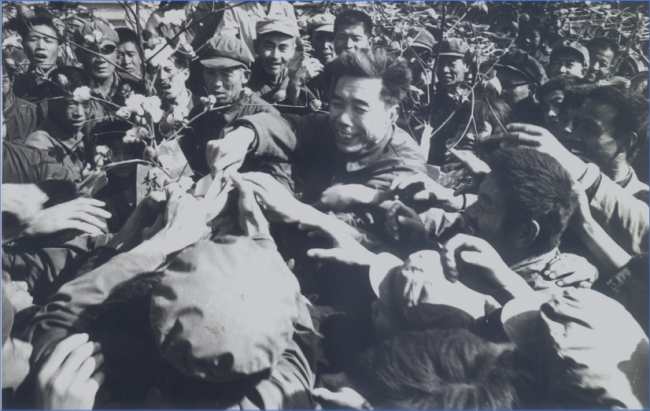
Mianhua county magistrate distributed leaflets.
I’ve been interviewing in the countryside for so long, and it’s the first time I’ve encountered such a vivid picture. When scrutinizing the description of this picture, I pondered for a long time around the words "Mianhua County magistrate scattered leaflets". It is the implementation of the rural contract responsibility system that has stimulated the production enthusiasm of hundreds of millions of farmers and made them devote themselves to labor with unprecedented enthusiasm. Science and technology symbolized by "science and technology leaflets" has become the most desirable and eager thing for farmers.
The act of asking for leaflets expresses the essence of farmers marching into science and technology, and they can feel the formation process of new productive forces. The composition of the stars holding the moon shows the farmers’ mood of "grabbing" and their desire for food.
By thinking in reverse, we can enter another realm. Considering the Party’s leadership work, the important content of the political line of the Third Plenary Session of the Eleventh Central Committee is the end of large-scale mass political movement and the beginning of large-scale production and construction.
At that time, the more I thought about it, the more excited I felt that I had captured an important plot, revealed a major theme and reflected the arrival of a new era. Later, these understandings were also endorsed by the press and photography circles in China, and many colleagues spoke highly of this photo. Wu Suxin’s article "Reflecting the pulse of the times-< Mianhua County magistrate scattered leaflets >" also believes that:
This photo has a good theme, a good theme and a vivid image. A county magistrate is so familiar with agricultural production technology that he is praised as "cotton county magistrate" by farmers, which itself reflects the changes in the ranks of cadres in China, the new pattern of the relationship between cadres and masses in rural areas and the new trend of agricultural development. This theme can be said to be a typical theme that deepens the theme.
I took some photos of old people distributing leaflets at the market. At that time, some people were afraid of disagreeing, so why did they distribute leaflets? I said that during the Cultural Revolution, people scattered leaflets to consolidate cadres. Now, cadres scattered leaflets to lead the people to get rich, and a new era has arrived. This photo proves the changes in the era of the Third Plenary Session.
After this photo was published in People’s Daily, it caused a sensation all over the country. It also brought changes to the fate of the elderly. Later, the old man was transferred to the Shandong Provincial Department of Agriculture as the director, and the old man has been to my house for more than 40 years.
I often think of this old man named Ding Nuo, but he disappeared after a long time.
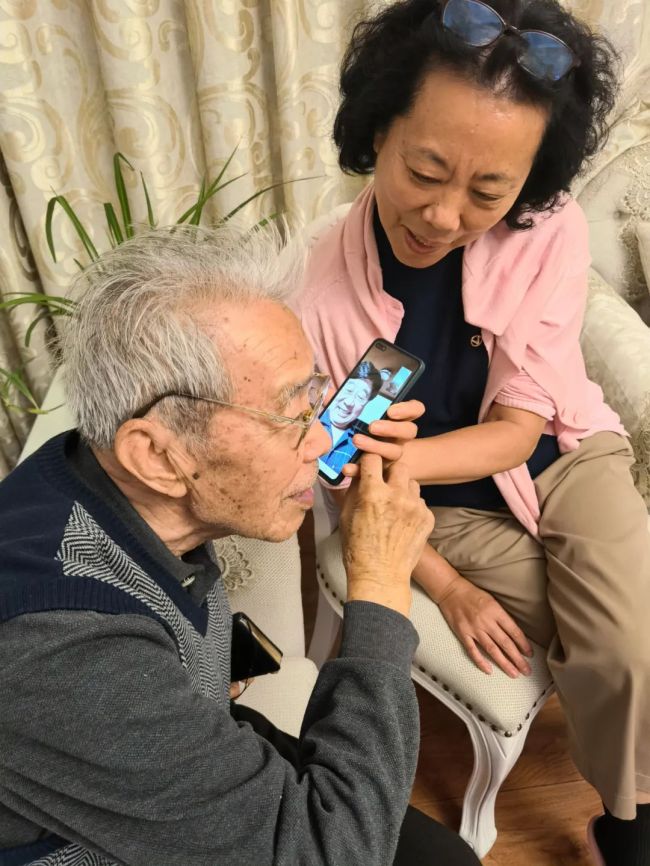
In Qingdao sanatorium, the wife took out the phone. I talked with Dino on video in other places, which made me feel very cordial.
The old man wrote poems praising "the population on the road is like a monument"
My daughter felt a little proud. She said, "When I went to the road, everyone I knew knew knew my father. My father did too many good things for the people."
In the evening, the old man visited my wife’s room specially. The old man didn’t rest at noon and wrote a long article. A 93-year-old man was full of true feelings, which moved people.
We met 40 years ago, it was May Day in chiping, Liaocheng in 1981. On November 9th of the same year, the headline of People’s Daily published your photos of the cotton harvest in chiping Cotton Station and my photos of promoting cotton technology in the big collection. I heard that I won a grand prize and named my daughter Li Mian.
Over the years, you have traveled from state to state, stayed in the countryside, and worked hard. You always said simple and useful things, and you always did the right and useful things. You always have the pursuit of perfection, and you always adhere to the work style of seeking truth from facts.
Politically, you are very proficient.
Ideologically, it is very refined.
At work, very capable.
Style, very sophisticated.
Business, very skilled.
Treat people with sincerity and conciseness.
I advise you not to engrave stubborn stones, and the population on the road is like a monument.
Old acquaintance and old friend JIU San Weng Ding Nuo
On October 13, 2021, he was treated in youth.
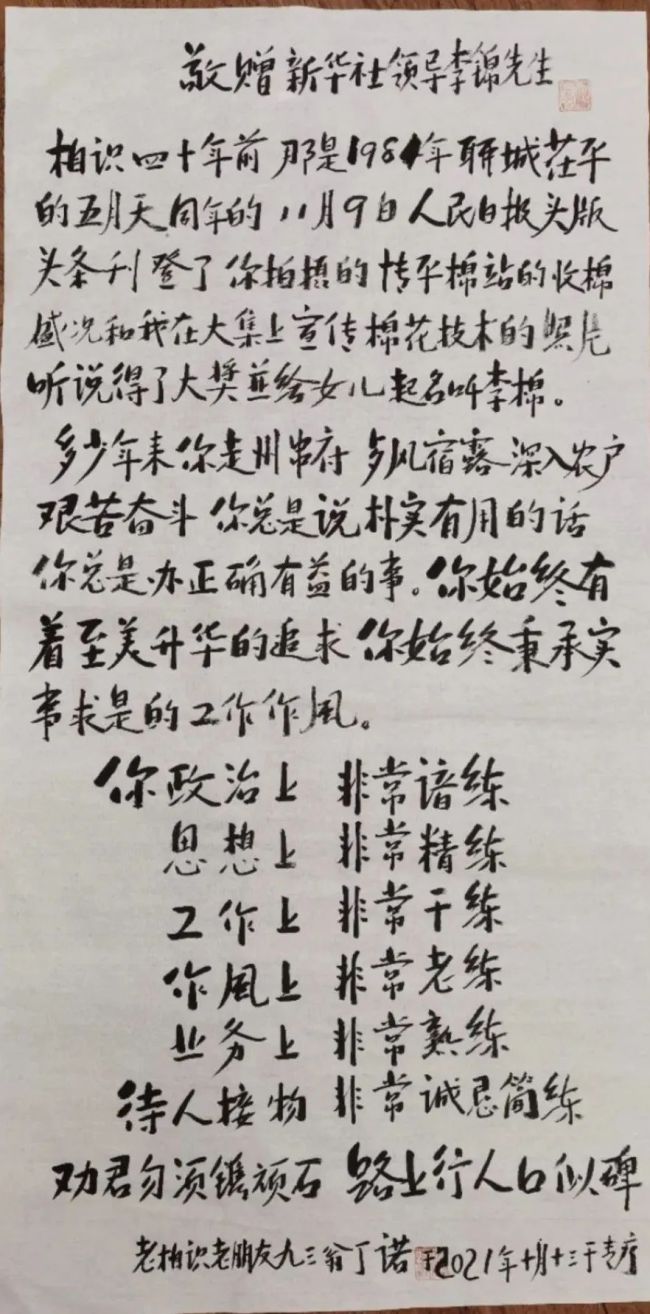
The old man praised me. How can I do so well?
This matter was not published at that time. I said it would be published in another month, in 40 years. It’s been more than a month. Xiao Liu reminded me that November 9 was not about anything.
At that time, I did say that I would write this matter on November 9. Liao Luchuan, Qian Han and Liang Hongwen invited me to dinner this evening. On the way, Xiao Liu sent a text message to remind him: "Teacher, today is still your festival, so it’s time for you to send the headlines." Ok, I said that on the way to dinner now, I will dictate it to you, you sort it out, and I will send photos when I get home tonight.
Today’s news is tomorrow’s history and yesterday’s history is today’s news. Journalists’ life is always like a birthday. Whenever they encounter these important reports, they always leave a lot of memories. It is a very meaningful article to salvage the memory.
A little feeling about "the population on the road is like a monument"
Senior Ding Nuo was born in 1928, the same age as my father. An experience and a manuscript 40 years ago made him remember Xinhua News Agency all his life, carved in his heart like a stone tablet. "The population on the road is like a monument", which caught my thoughts for a long time.
When the prosperity is exhausted, you will see the truth. There is a kind of reputation, which is recognized or selected by superiors, while others are passed down from mouth to mouth by the people. It is a sign. The difference lies in whether it is said above or below; Say it yourself or the people; For a while or for a long time. Many works of Xinhua News Agency were evaluated by leaders. In order to evaluate the draft, dogs tore cats and bit them, and some beat their heads off. However, when the next leader left, no one said anything; I left by myself, and I didn’t say anything. But it has been circulating in the society for a long time, and it belongs to the gold content. My "Joy of Cotton Girl" has been in the exhibition hall of national history and party history, and it has been circulating in Zhangqiu for a long time. My nine-shed model, from the spirit of nine-shed to the spirit of Yimeng, has also been remembered by Linyi people for a long time; My report on ten thousand households was also remembered by people in Liaocheng, and my happiness phenomenon was also remembered by people in Binzhou.
"The population on the road is like a monument", which means that the real monument should be engraved in people’s hearts. It also means that right and wrong do not need to be defended by themselves, and they have their own public opinion to decide. A good reputation, like a clean stream, is not only an individual’s life attitude and value pursuit, but also a long-lasting spiritual yearning of the whole society. I think it is also a realm of life for a reporter to do this.
Things are like grass growing in spring, but people are like floating clouds. A good reputation, like a clean stream, is closely related to the happy life of ordinary people. Han Yu and Su Shi, who were relegated to the wild land as criminal ministers, are generous and diligent. Now Han Jiang in Chaozhou is still running day and night, and Su Causeway is still quietly guarding the West Lake. It can be seen that the clean stream seems invisible, but in fact it is tangible, and the people can really feel and experience it, and finally form a word of mouth. As frankly stated in Disciples’ Rules, "those who go high have a high name; Those who are talented are arrogant. " I can’t compare the land with the sky, but I believe that what journalists left to history will also remain immortal. To achieve the realm of "the population on the road is like a monument".
"I advise you not to engrave stubborn stones, and the population on the road is like a monument." A good reputation is the spiritual treatment given to a person by society, just like the air flowing among the public. As long as a journalist has an elegant mind, is full of righteousness, does more good deeds, and engraves his works on the hearts of the people, he is naturally confident that he will "stay clean in the world." I have been engaged in journalism for 50 years, and many of my works have been made in Shandong. Many places have left an impression on the people, and they are still talking about it, and they have even set up a memorial hall for my works. I thank the people here.
Today, I am glad to remember the accidental meeting between Mr. Ding Nuo and my wife and daughter and leave the above article.
Today is another festival, which is the 40th anniversary of the headline of People’s Daily and the leaflet of Mianhua County. It has been 40 years since he published articles to commemorate the harvest of cotton in northwest Shandong and the early years of rural reform.(Li Jin)
Brief introduction of the author
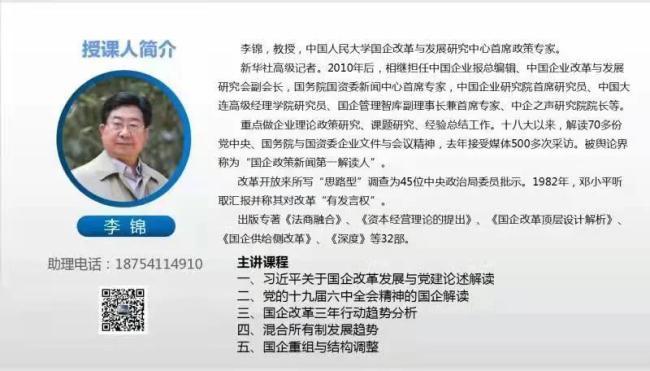
Li Jin,Professor, Chief Policy Expert, State-owned Enterprise Reform and Development Research Center, Renmin University of China.
Senior reporter of Xinhua News Agency. Since 2010, he has successively served as editor-in-chief of China Enterprise News, vice president of China Enterprise Reform and Development Research Association, chief expert of the State Council State-owned Assets Supervision and Administration Commission, vice chairman and chief expert of state-owned enterprise management think tank, and president of China Enterprise Voice Research Institute.
Focus on enterprise theory and policy research, subject research and experience summary. Since the 18th National Congress, he has interpreted more than 70 corporate documents of the CPC Central Committee, the State Council and SASAC and the spirit of the meeting, and was interviewed by the media for more than 500 times last year. He was called "the standard-bearer of public opinion on the reform of state-owned enterprises in China" and "the first interpreter of state-owned enterprise policy news" by the media.
Since the reform and opening up, the "thinking-oriented" survey has been written by 45 members of the Political Bureau of the Communist Party of China Central Committee. In 1982, Deng Xiaoping listened to the report and said that he had a "say" in the reform.
He has published 32 monographs, such as The Proposition of Capital Management Theory and Depth.